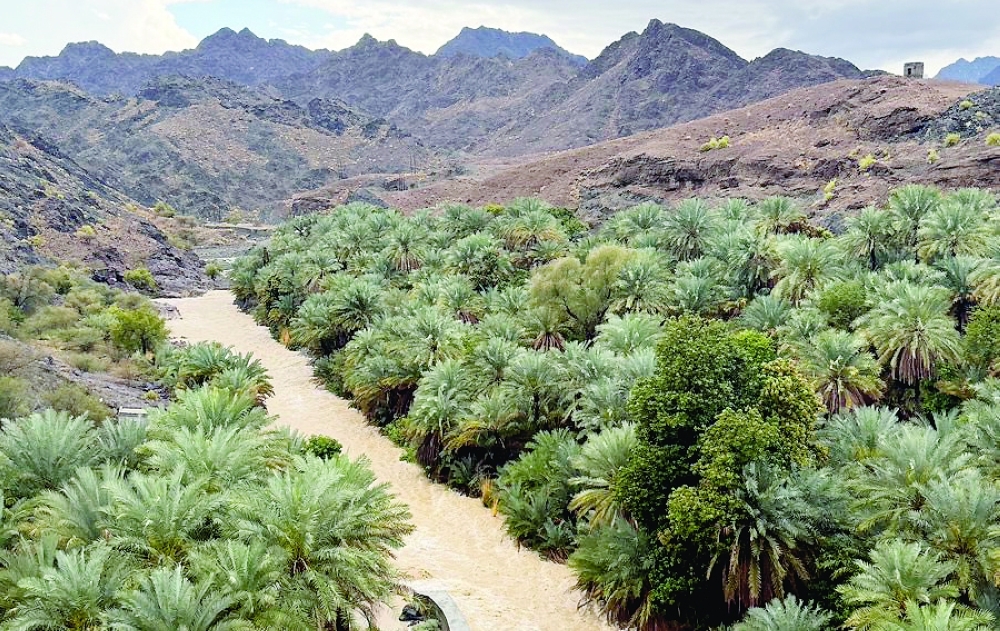





MUSCAT: A recent study by Dr Ghazi bin Ali al Rawas from the College of Engineering at Sultan Qaboos University (SQU) has highlighted the need for an integrated approach to flood management in Wadi Al Sarmi in Al Batinah North, demonstrating that effective flood mitigation requires coordinated planning across entire wadi catchments rather than treating upstream and downstream areas separately.
The study examined flash flooding in Wadi Al Sarmi, viewing it not merely as a hydrological phenomenon but as a challenge shaped by geographical conditions, urban development, and public management.
The researchers emphasised that floodwaters originating in the mountainous headwaters continue downstream into urban areas, where they pose significant risks to communities and infrastructure.
According to the study, the Al Batinah North coastal plain has experienced repeated severe flooding in recent years. Its low-lying coastal landscape, combined with rapid urban expansion, has increased flood vulnerability and highlighted the need for more comprehensive flood management strategies.
To investigate the problem, the research team employed the Storm Water Management Model (SWMM) to simulate hydrological and hydraulic behaviour across both upstream and downstream sections of the catchment.
The researchers argued that flood management in catchments comprising rural upper reaches and urban lower reaches should be designed as a single integrated system rather than through separate interventions.
The proposed methodology began with optimising the locations and dimensions of detention dams in the upstream non-urban area using a multi-objective optimisation framework.
Candidate scenarios were then evaluated using the Complex Proportional Assessment (COPRAS) method, while Backward Induction Game Theory (BIGT) was applied to resolve competing priorities among stakeholders. Based on the selected scenario, the urban drainage network was subsequently redesigned to complement upstream flood-control measures.
Beyond engineering solutions, the study incorporated game theory to analyse interactions among key stakeholders and identify a balanced solution that reconciles upstream and downstream flood management objectives.
This approach sought to minimise conflicts between institutions while accommodating the priorities of organisations such as the Ministry of Agriculture, Fisheries and Water Resources and Sohar Municipality.
Compared with the baseline scenario, the selected flood management strategy reduced peak flow entering urban areas by 60.7 per cent. It also increased the drainage network's flood absorption capacity to 81.8 per cent, indicating a substantially improved ability to accommodate flood volumes and reduce their impacts.
The proposed plan includes 11 detention dams strategically distributed throughout the catchment. The largest of these, identified as Dam D3, has a height of 10.9 metres, reflecting a design tailored to the valley's topography and flow characteristics rather than relying on a single standard solution.
The researchers concluded that effective flood management cannot be achieved by addressing only upstream or downstream areas in isolation.
Instead, the entire catchment should be managed as a unified system that combines accurate modelling, well-designed infrastructure, and strong institutional coordination.
Such an integrated approach enables a shift from reactive flood response to proactive, long-term flood risk management.
Oman Observer is now on the WhatsApp channel. Click here